

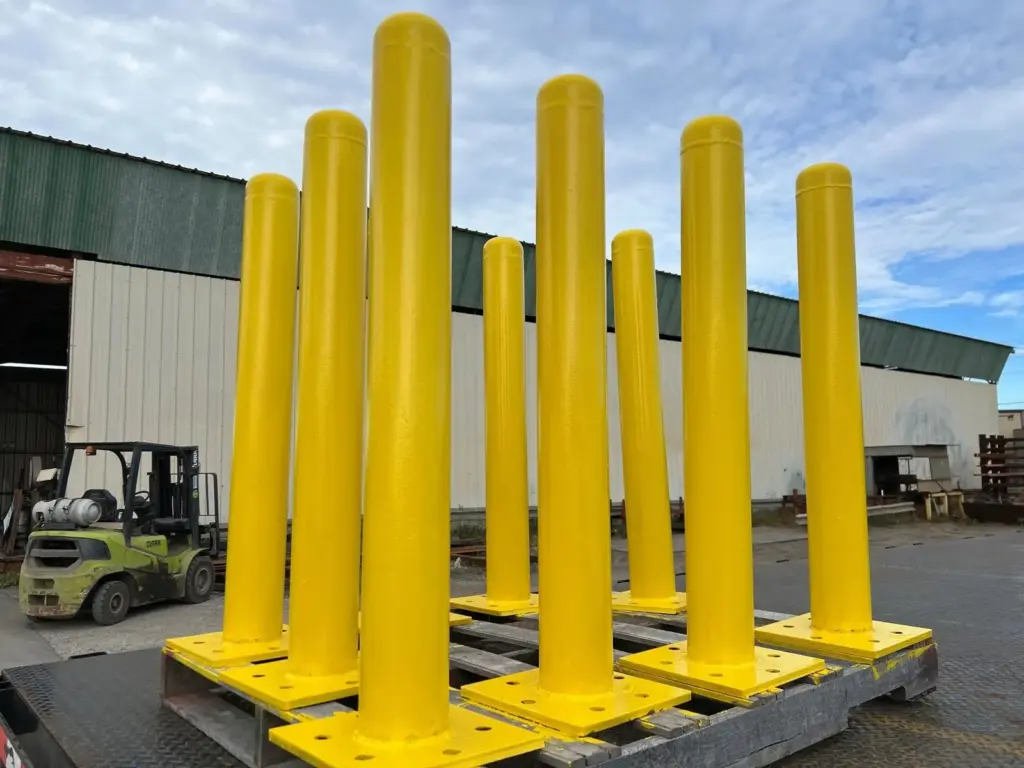
What Size Pipe Do You Need for a Bollard?
Bollard diameter is a question of what you’re stopping and how fast it’s moving. Bigger pipe and thicker wall means more resistance to impact — but past a certain point you’re paying for steel that the situation doesn’t call for.
6″ bollards are the size we sell most of, and the one to default to unless you have a reason not to. They’re the workhorse for storefronts, drive-through lanes, dock corners, and anywhere delivery trucks maneuver. If you’re protecting glass, a doorway people stand behind, or anything a truck backs toward, this is the size.
4″ bollards handle lighter, lower-speed protection: parking-lot corners, gas meters, HVAC units, air compressors, warehouse racking ends, and bike-rack areas. Where the worst case is a car creeping into something at walking speed, 4″ is enough and costs less.
8″ bollards are for heavy industrial traffic — forklift aisles, truck courts, fuel islands, and equipment that absolutely cannot be hit. Also used where the bollard doubles as a structural post.
A note on crash ratings: the bollards we supply are protective barriers, not certified anti-ram security bollards. If your project specifies a crash rating (ASTM F3016 or F2656 / “K-rated” for federal and high-security work), that’s a different engineered product and you’ll need a rated system with a designed foundation. For everyday property and equipment protection — which is the vast majority of bollard jobs — standard pipe set in concrete is what’s specified and what works.
Bollard Pipe Sizes & Weights
We stock bollard pipe in two walls: .188″ (3/16″), which is what most bollard orders use, and heavier Schedule 40 when a job calls for more steel. Galvanized runs roughly 2–3% heavier than the figures below with the zinc coating. Both walls are stocked in bare steel across all three diameters. Galvanized is stocked in Schedule 40 only. Schedule 80 is available on request for high-impact locations.
| Nominal Size | Outside Diameter | .188″ Wall | Sch. 40 Wall | Typical Application |
|---|---|---|---|---|
| 4″ | 4.500″ | 8.66 lb/ft | 10.79 lb/ft (.237″) | Gas meters, HVAC units, racking ends, lot corners |
| 6″ | 6.625″ | 12.92 lb/ft | 18.97 lb/ft (.280″) | Most common. Storefronts, dock corners, drive-throughs |
| 8″ | 8.625″ | 16.94 lb/ft | 28.55 lb/ft (.322″) | Forklift aisles, truck courts, fuel islands |
To estimate the pipe you need per bollard: add your finished above-grade height to your embedment depth, then add a few inches for cut tolerance. A 42″ tall 6″ bollard set 42″ deep needs about 7’6″ of pipe — roughly 97 lb in .188″ wall, or 142 lb in Schedule 40.
Which Wall Thickness Do You Actually Need?
Less than most people assume, if you’re filling the bollards with concrete — which most jobs do. Once a pipe is packed with concrete, the fill carries a large share of the load and transfers it into the footing, so the difference between .188″ and Schedule 40 wall matters less to the finished bollard’s performance than the diameter, the depth it’s set, and the concrete does.
That’s why .188″ wall is the most common thing we sell. It’s lighter, it costs less per foot, it’s easier to handle and cut, and filled with concrete it does the job on the overwhelming majority of property-protection installs.
Step up to Schedule 40 when the bollard is staying hollow, when it’s taking repeated contact rather than a once-in-a-decade accident (forklift aisles are the classic case), when a spec or an engineer calls for a specific wall, when the bollard is doing structural work as well as protective work, or when you are ordering galvanized, which we stock in Schedule 40 only.
If you’re not sure, tell us what you’re protecting and we’ll tell you which wall we’d send.
How Deep Should a Bollard Be Set?
The common rule of thumb is to bury roughly a third to half of the bollard’s total length, with a minimum footing depth of about 36″. Deeper is better in sandy Central Florida soil, which offers less lateral resistance than clay.
General practice for a standard fixed bollard:
- Finished height above grade: 36″ to 42″. Lower than 36″ and drivers lose sight of it over a hood; taller than 48″ and it starts to look like a post rather than a barrier.
- Footing depth: 36″ to 48″ for most commercial applications.
- Hole diameter: about three times the pipe diameter — so roughly a 12″ hole for a 4″ bollard, 18″ for a 6″.
- Concrete: fill the hole and fill the pipe, then crown the top so water runs off instead of sitting inside.
This is general guidance, not an engineering specification. Footing design depends on soil conditions, what’s buried below, and what the bollard is protecting — and any bollard installed as a required vehicle barrier under building code (IBC Section 312 covers vehicle impact protection) should be reviewed against your local code and, where warranted, by an engineer. Call us and we’ll help you figure out the pipe; your site conditions determine the hole.
Should You Fill Bollards with Concrete?
Usually yes. Concrete-filled pipe resists deformation far better than hollow pipe — an empty bollard tends to dent and fold at the impact point, while a filled one transfers load down into the footing. Filling also keeps water out of the pipe interior, which is where corrosion starts from the inside. And as covered above, it’s a big part of why a lighter .188″ wall performs well on most installs.
The main exception is where a designer deliberately leaves pipe unfilled because they want the bollard to crumple and absorb energy instead of stopping a vehicle dead. That’s a deliberate engineering choice, not a default. Unless you have a specific reason not to, fill them.
Crown the concrete at the top — a slight dome rather than a flat pour — so rain sheds off. A flat or dished top holds standing water against the steel and shortens the life of the finish considerably in Florida’s climate.
Steel vs. Galvanized Bollards
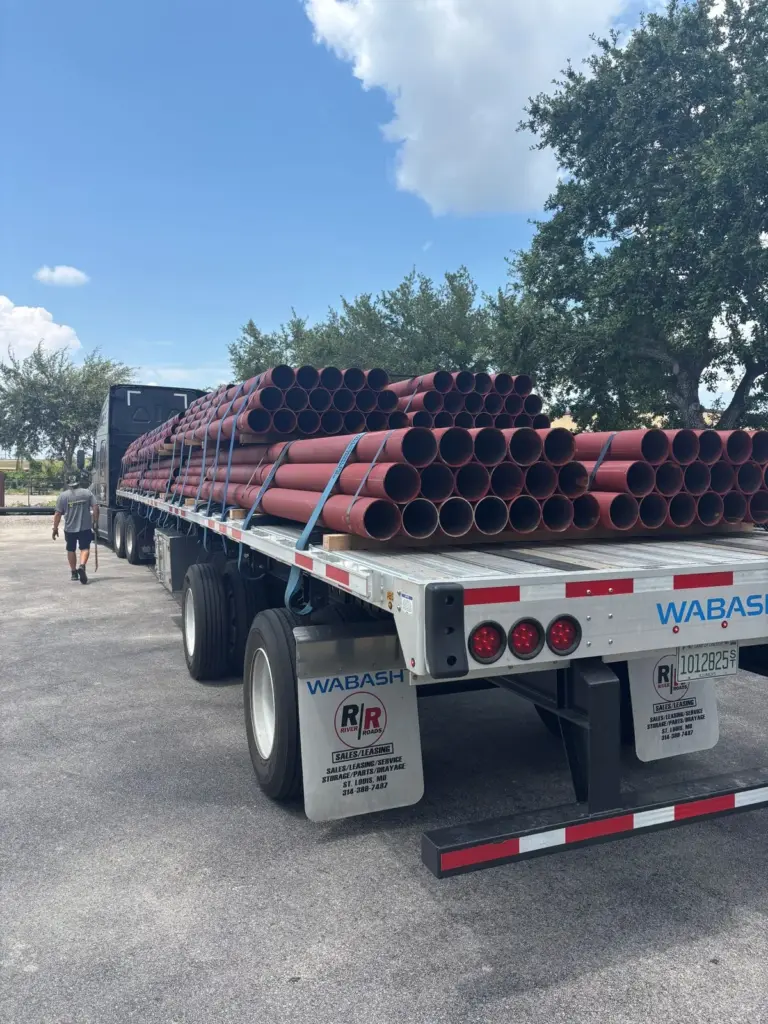
Both start as the same pipe. The difference is corrosion protection and what it costs you over time.
Bare steel bollards cost less up front and take paint well. They’re the right call when the bollard is getting a finish coat anyway — DOT yellow, a brand color, or a plastic cover. In Florida, bare steel that isn’t painted or covered will show rust within a season.
Galvanized bollards are hot-dip coated in zinc, which sacrifices itself to protect the steel underneath. Worth the premium for coastal and salt-air locations, unpainted installations, wet areas like wash bays and irrigation-adjacent sites, and anywhere a maintenance crew isn’t going to come back and repaint. Galvanized needs no paint at all — the natural silver-grey finish is the finish.
For most Central Florida outdoor installations where the bollard won’t be repainted on a schedule, galvanized is the lower total-cost choice even though it’s more per foot. Galvanized is stocked in Schedule 40 only, so choosing galvanized also means choosing the heavier wall.
Our finish options: primer painted red, primer painted grey, DOT yellow, and custom color finishing. Primer-painted bollards are meant to receive a topcoat — they’re not a finished product on their own.
Bollard Paint & Covers
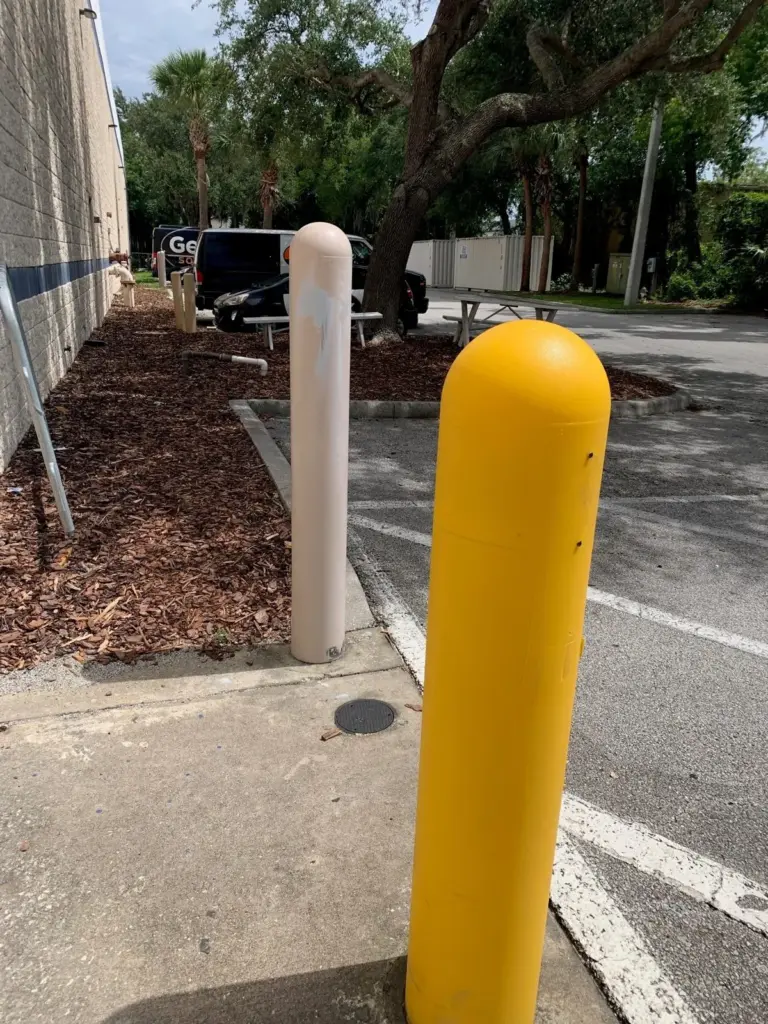
Paint. Safety yellow is the default for a reason: it reads as a hazard marker without anyone having to be told. If you’re painting bare steel yourself, prime first — direct topcoat over mill scale won’t hold. Retail and hospitality sites often go the other direction and paint bollards to match trim so the barrier disappears into the building; that works fine as long as the bollard is still visible enough that drivers see it.
Covers. Plastic bollard sleeves slip over the pipe and eliminate repainting entirely. They stay bright, resist UV fading, and hide the scuffs and scrapes that any working bollard accumulates. For customer-facing storefronts where a dented, chalked-out yellow bollard reads as neglect, covers are usually cheaper than the recurring labor of repainting. We stock DOT yellow covers.
Fixed vs. Surface-Mounted Bollards
Fixed (in-ground) bollards are set directly in concrete — dig the hole, set the pipe, fill around it and inside it. Strongest option, lowest material cost, nothing to maintain. This is what most jobs use, and it’s what the depth guidance above applies to.
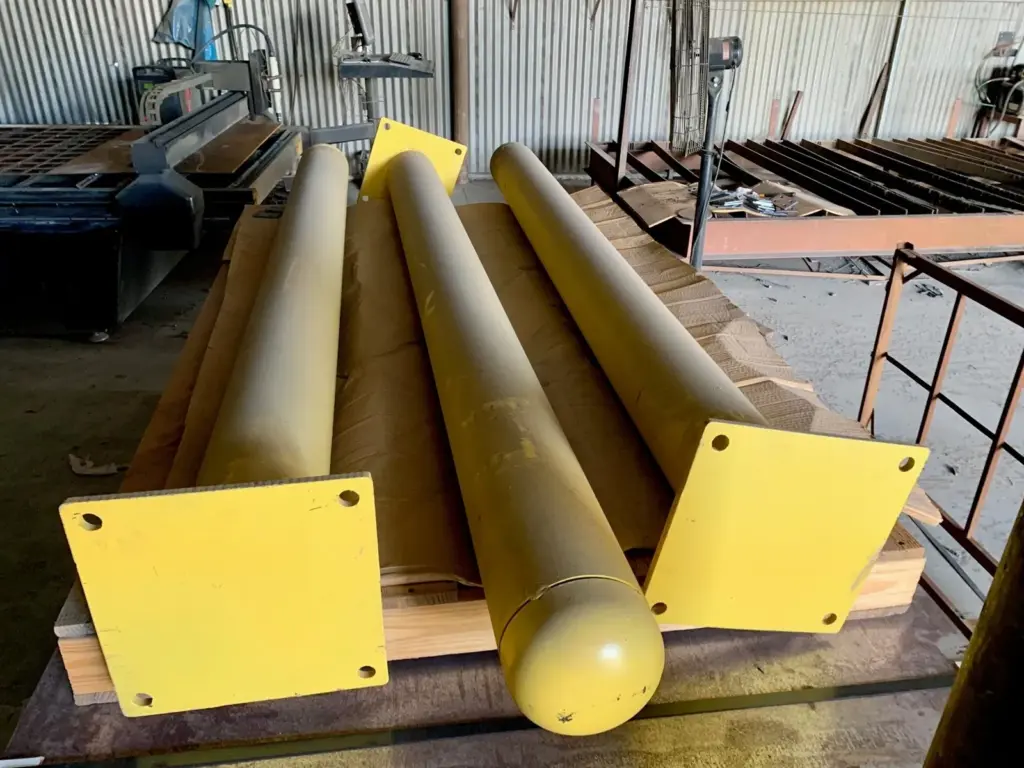
Surface-mounted bollards are welded to a steel base plate and anchored down onto concrete that’s already there. This is the answer when you can’t or don’t want to cut and patch a slab: existing parking lots, warehouse and plant floors, loading docks already poured, leased spaces where coring the concrete isn’t allowed, and jobs that need to be finished in an afternoon instead of waiting on a cure.
The trade-off is strength. With a surface mount, the anchors and the slab they’re bolted into become the limiting factor rather than the pipe, so a base-plate bollard will not take the hit an in-ground one will. Match the plate size and anchor spec to the slab thickness, and don’t put a surface mount where you’re expecting to actually stop a moving vehicle. We can weld the base plate to the pipe in house and send you a finished surface-mount bollard, or supply the pipe and the plate for your contractor to weld on site. Tell us which you need when you request a quote.
Spacing between bollards typically runs 4 to 5 feet on center for pedestrian and storefront protection. Keep it tight enough that a vehicle can’t fit between two of them, but be careful around accessible routes: ADA requires a minimum clear width for accessible paths, so check spacing against your accessibility requirements before setting anything in concrete.
One thing we don’t sell: true removable or retractable bollards — the kind that lift out of an in-ground receiver sleeve or telescope down flush with the pavement. Those are engineered systems with their own receivers and hardware, and they’re a different product from cut pipe. If you need a lift-out, we’ll tell you so rather than sell you something that won’t do it.
Bollard Pipe Cut to Length in Apopka
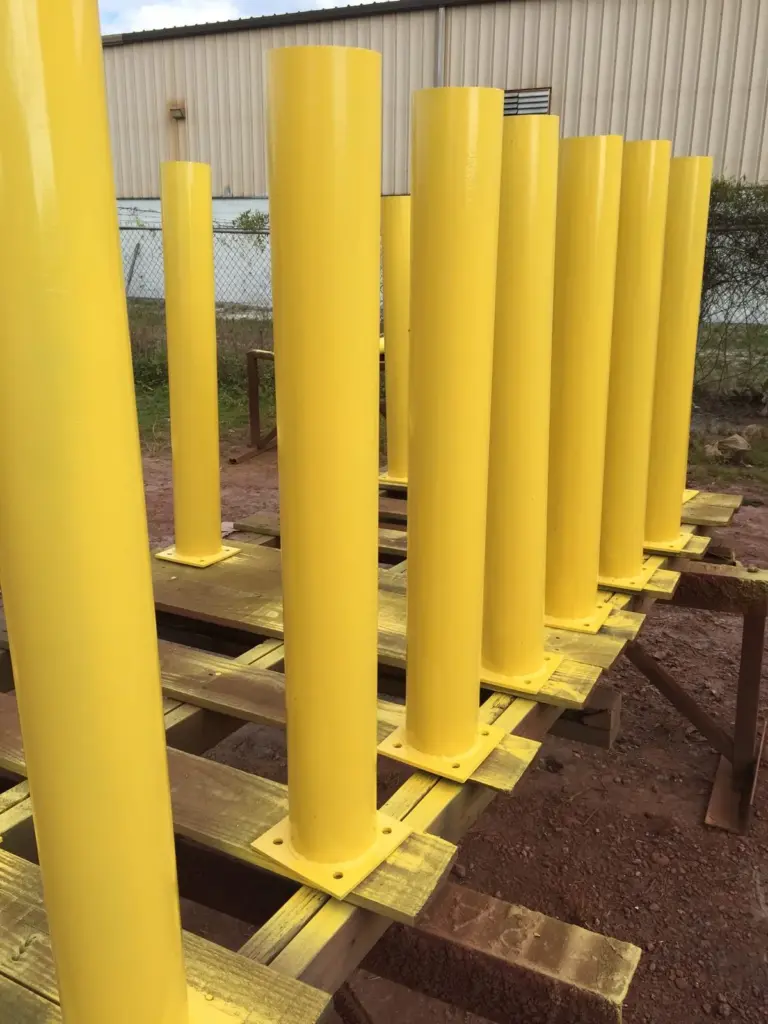
Give us your height and quantity and we’ll cut it. Our Apopka yard saw- and torch-cuts pipe in-house, so most bollard orders are ready same-day or next-day.
- Saw cutting on every diameter we stock
- Torch cutting for heavier and larger pipe
- Any height — 36″, 42″, or a custom cut list per location
- One bollard or a full truckload, no minimums